Who is a member?
Our members are the local governments of Massachusetts and their elected and appointed leadership.


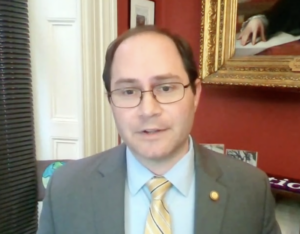
Salem Mayor Dominick Pangallo testifies before the Joint Committee on Revenue during a Nov. 7 hybrid hearing on the proposed Municipal Empowerment Act in Gardner.
The three legislative committees assigned sections of the governor’s proposed Municipal Empowerment Act concluded their hearings on Nov. 7.
The wide-ranging bill, strongly supported by the MMA and local leaders, is intended to increase municipal flexibility, reduce administrative burdens, strengthen municipal finances, address municipal workforce challenges, and improve the efficiency of local operations.
The bill was first filed in 2024, and was re-filed in January with some additional provisions.
This session’s bill was assigned to three committees: the Joint Committee on Public Service, the Joint Committee on Municipalities and Regional Government, and the Joint Committee on Revenue.
The Public Service Committee held the first hearing, on Sept. 22, and focused on two provisions of the bill:
• To allow municipalities to apply for a critical shortage exemption from certain post-retirement limitations on employment for specific job titles and classes for a period of three years
• To establish an Other Post-Employment Benefits Commission to address unfunded liabilities from non-pension employee benefits
The Municipalities and Regional Government Committee, which holds a bulk of the bill’s provisions, held its hearing on Oct. 28. Nearly 20 officials from the Healey-Driscoll administration and cities and towns testified on the importance of the bill, focusing on provisions including:
• Making the current remote and hybrid meeting flexibilities for public meetings permanent
• Reforming procurement procedures and regulations, including increasing the threshold for all municipal purchases under Chapter 30B, streamlining cooperative purchasing agreements, and including snowhauling services with snowplowing services as exempt from 30B rules
• Updating borrowing rules for school projects by extending the borrowing term to 40 years
• Establishing enforcement mechanisms for prohibitions on doubled-up utility poles
The Revenue Committee held the final hearing, on Nov. 7, focused on the local-option tax provisions in the bill, including:
• Extending property tax exemptions for seniors
• Increasing the maximum local-option meals tax from 0.75% to 1%
• Increasing the local-option tax on hotels, motels and other short-term rentals from 6% to 7% (and 6.5% to 7.5% in Boston)
• Allowing a surcharge to assessed motor vehicle excise taxes by up to 5%
The three committees must now recommend which items may be pushed forward in the legislative process.