Who is a member?
Our members are the local governments of Massachusetts and their elected and appointed leadership.


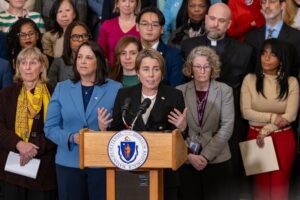
At a Jan. 29 press conference at the State House, Gov. Maura Healey announces her bill to prohibit Immigration and Customs Enforcement from entering courthouses, schools, child care centers, hospitals and places of worship. (Photo courtesy Joshua Qualls/Governor’s Press Office)
Gov. Maura Healey on Jan. 29 filed legislation to keep federal Immigration and Customs Enforcement personnel out of courthouses, schools, child care programs, hospitals and houses of worship.
The legislation would also make it unlawful for another state to deploy its National Guard in Massachusetts without the governor’s permission, and would allow parents to pre-arrange guardianship for their children in case they are detained or deported by federal authorities.
Healey said her bill is the most comprehensive effort in the country to protect against ICE activity in sensitive locations. The provisions were included in a fiscal 2026 supplemental budget bill that proposes $411.3 million in time-sensitive appropriations for deficiencies.
The governor also signed an Executive Order prohibiting ICE from making civil arrests in non-public areas of state facilities, and prohibiting the use of state property for immigration enforcement staging.
The Executive Order also prohibits the state from entering into any new agreements — known as 287(g) — to empower local police to identify, detain, and process noncitizens for removal, primarily within jail settings, unless there is a public safety need.
The Executive Order directs the Executive Office of Education and the Executive Office of Health and Human Services to support public and private entities in developing policies and guidance on interacting with ICE.
“In Massachusetts and across the country, we continue to see unlawful and unconstitutional actions by ICE that are meant to intimidate and instill fear in our communities, including against United States citizens who are exercising their constitutional rights,” Healey said in a prepared statement. “I find it necessary in the interest of public safety to take this action today.”
For decades, the Department of Homeland Security maintained a “protected areas” policy requiring ICE to refrain from immigration enforcement actions in sensitive locations, including hospitals, houses of worship, courts, and school programs. According to the administration, the policy allowed all community members to access basic support and services without fear, and protected public safety by encouraging all people to seek necessary medical care and testify in court when necessary, whether as a victim, witness, or party.
On Jan. 20, 2025, the Trump administration rescinded the protected areas policy, replacing it with a directive giving ICE agents power to take enforcement actions in medical facilities, houses of worship, courts, schools and child care programs.
Healey said her legislation would restore the longstanding protections against arrests by ICE agents in essential spaces where families, children, and vulnerable people should feel safe.
Mary Bourque, executive director of the Massachusetts Association of School Superintendents, thanked the Healey-Driscoll administration for its efforts “to ensure that parents can send their children to school every day without fear.”
“Our students, families, and educators continue to live in terror and trauma because of the cruel and often unlawful acts of federal ICE agents,” she said.
Courthouses
Healey said ICE’s presence at courthouses creates confusion and deters witnesses, victims and litigants from coming to court, resulting in the dismissal of some charges and release of defendants. Her bill would ban warrantless civil arrests by ICE agents inside of courthouses.
Schools and child care
Healey said school enrollment has declined dramatically in districts with high populations of immigrant students this school year, with record declines of more than 5% in Chelsea and Everett. The revocation of the protected areas policy has allowed ICE agents to target schools and child care programs. As a result, some families have been fearful of sending their children to child care or school, or participating in sports or school events like graduation ceremonies.
Healey’s legislation would prohibit elementary, middle and high schools, as well as licensed child care programs and after school programs, from allowing an ICE or immigration agent to enter the premises without a judicial warrant. Schools, child care programs, and after school programs will also be required to adopt and implement their own policies on how to interact with or respond to requests from ICE agents, in line with guidance issued by the Healey-Driscoll administration and Attorney General Andrea Campbell.
Health care
Health care providers have been reporting that more immigrant families are skipping medical appointments, delaying care or canceling their health insurance because they fear being detained by ICE. Hospitals also used to fall under the protected areas policy until it was revoked by President Trump.
Healey’s legislation would prohibit hospitals, community health centers, nursing homes, and substance use disorder programs from granting ICE access to nonpublic areas without a judicial warrant. These facilities will also be required to issue policies on how their staff and volunteers should interact with or respond to requests from ICE.
Houses of worship
The cancellation of the protected areas policy has deterred many immigrants from attending religious services, as reported by religious organizations across the country. Healey’s legislation would codify a statutory privilege against civil arrest for individuals within places of worship while attending services, protecting the First Amendment right of free exercise of religion.
Other provisions
In addition to the supplemental appropriations, the governor’s bill proposes reforms to veterans benefits access to ensure eligible veterans are able to obtain state benefits even if they are denied federal benefits. There are also indemnification provisions to protect public employees acting within the scope of their duties in connection with federal investigations, and technical and privacy-related amendments affecting higher education access and student records.
The legislation includes a time-sensitive proposal that would allow for the Joint Hazard Incident Response Team to proactively work together and coordinate for large scale events, such as the World Cup or Tall Ships.