Who is a member?
Our members are the local governments of Massachusetts and their elected and appointed leadership.

MMA Innovation Award winner, From The Beacon, February 2026
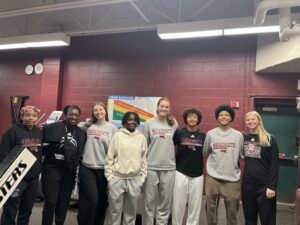
Members of the women’s basketball team at UMass Amherst gather with Amherst public school students participating in the town’s Morning Movement and Mentoring Program, which gives students in grades seven through nine space and time before school to engage in activities that bolster their physical wellness, mental health and preparedness, and sense of belonging. (Photo courtesy town of Amherst)
A small, informal effort to motivate Amherst students in the early morning has grown over the past few years into a town initiative that engages about 100 students from grades seven through nine before classes start for the day.
Three times per week, Amherst’s Morning Movement and Mentoring Program offers an early-morning space for students to play sports, lift weights, participate in arts and crafts and other activities, interact with mentors, and get homework help. The program — a partnership involving town departments, the schools and external institutions — aims to bolster students’ physical wellness, mental health and preparedness, and sense of belonging.
With extensive community buy-in, program leaders said that Morning Movement and Mentoring has transformed the lives of many students, resulting in better communication between students and adults, improved school attendance and academic performance, realistic goal-setting, and better behavioral and emotional outcomes.
“That’s what it really takes when you’re working with, particularly the subset of youth that we’re working with — it takes a village to find the resources to give them access to the tools that will help them be successful long term,” said Recreation Outreach Director Becky Demling. “And I feel like that’s one thing we’ve done really well with Morning Movement, is build those partnerships.”
The program began several years ago when Seiha Krouch, a paraeducator in the Amherst schools, began hosting kids in the high school gym and weight room to motivate them before school. Krouch, a Cambodian refugee who found community in Amherst as a child, sought to pass on that sense of belonging to students.
“My goal is and will forever be to give youth a safe place and space to exercise before and after school,” Krouch said in a statement about the program. “My other goal is to develop trust with youth, create friendships, and demonstrate what a big family is about.”
Krouch’s work soon got wider attention, as it aligned with the school district’s work to support more at-risk families and children with additional services. In 2023, the town started providing transportation to kids with the greatest need, and offering other resources. Now, of the nearly 100 students registered, roughly 50 students show up on any given day.
The initiative involves numerous partners, including the Recreation Department and the schools; the police and fire departments; Community Responders for Equity, Safety and Service, or CRESS; the Hampshire County Sheriff’s Office; the Hampshire County Superior Court; Amherst College, and UMass Amherst, among others.
“I think [Amherst] has this great example of how you build a community,” said Marta Guevara, director of student and family engagement for the Amherst-Pelham Regional Public Schools. “You support students, you provide mentoring, and you prioritize well-being and success in life for all of your students.”
The program serves diverse populations. According to the town, the program’s participants self-identify as 25% Hispanic or Latino, 22.4% Black or African American, 22.4% white or Caucasian, 19.7% belonging to two or more races or ethnicities, and 6.6% Asian. Half of the students receive special education or disability-related services, and 60% qualify for free or reduced-price lunches.
The program focuses on students in grades seven through nine because those children are facing significant developmental transitions, including the progression to high school, Guevara said. Soon, the program will also involve older students as mentors.
Some of the program’s highlights have included field trips to college campuses, sporting events, and the State House. The mentoring relationships with adults from police, the colleges and other public and private agencies have also made a significant impact on the students, the program’s leaders said.
In particular, the interactions between the students and police mentors have helped build trust between police and youth and strengthen the community as a whole, officials said. Officer William Laramee, who makes the program a regular part of his workweek, works with the students on weight-room training.
“They’re lifting weights, they’re learning a skill,” Laramee said. “But it’s really about the connection.”
For more information, contact Recreation Outreach Director Becky Demling at [email protected].