Who is a member?
Our members are the local governments of Massachusetts and their elected and appointed leadership.


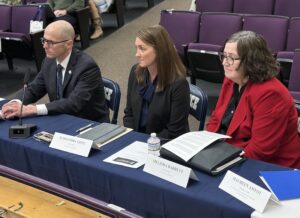
MMA Executive Director Adam Chapdelaine, left, MMA President and Amesbury Mayor Kassandra Gove, center, and Haverhill Mayor Melinda Barrett, right, testify during a hearing on the local aid areas of the fiscal 2027 state budget on March 23.
During a hearing on the local aid areas of the fiscal 2027 state budget on March 23, the MMA and local leaders called for a strategic and substantive increase to Unrestricted General Government Aid.
MMA Executive Director Adam Chapdelaine emphasized the importance of healthy cities and towns.
“Ultimately, the success of Massachusetts depends on the fiscal strength and stability of its cities and towns,” he told the Joint Committee on Ways and Means in Lawrence. “This is a core to any conversation of competitiveness or affordability. It’s another reason why additional investments for fiscal 2027 are an urgent issue for local taxpayers as well as the Commonwealth as a whole.”
Chapdelaine, joined by MMA President and Amesbury Mayor Kassandra Gove and Haverhill Mayor Melinda Barrett, expressed appreciation to legislators for recent investments in education and transportation programs, and for their leadership as economic conditions across the Commonwealth change.
The panel outlined the fiscal challenges facing nearly all cities and towns, as documented in two recent MMA reports, the essential nature of municipal services, and the need for greater state support.
“Cities and towns are the stewards of the foundational services and infrastructure necessary to everyday life,” Chapedelaine said. “Whether safe drinking water, solid waste management, road and bridge maintenance, protecting public health, emergency response, educating future generations, or securing elections — city and town governments are the bedrock of our economies. In order to maintain these foundational services, our local governments are in desperate need of additional state support.”
The MMA called for an infusion of funding for Unrestricted General Government Aid, referring to the program as “the pillar of our state and local partnership.”
On public education aid, Chapdelaine expressed support for the governor’s proposal to fully fund the sixth and final year of the Student Opportunity Act implementation schedule, and encouraged legislators to boost minimum per pupil aid to at least $150 per pupil, which would continue the level of funding included in the fiscal 2026 budget.
Gove discussed conditions on the ground in municipalities across Massachusetts, including her city.
“After a failed [Proposition 2½] override in November,” she said, “there’s no doubt that these changes impact the quality of services for residents.”
She emphasized the need for increases for UGGA and per pupil minimum aid, which would apply to 80% of all school districts, including Amesbury.
“For level service, we anticipate costs would increase roughly $791 per pupil — a far cry from the proposed $75,” she said. “I urge you to increase the per pupil aid so that the vast majority of districts are better supported in managing the increased costs needed to educate our youth.”
Barrett emphasized the pressure on Haverhill’s budget, in part due to local assessments outweighing state investments.
“Under the governor’s proposal, Haverhill would receive a combined $688,000 from Unrestricted General Government Aid and charter school tuition reimbursement,” she said. “However, the city faces a combined school choice and charter assessment burden of just over $1 million, a net reduction of $362,000 from fiscal 2026.”
Barrett added, “On the city side, our police force is undersized for our population. Our fire department has just recently been right-sized with the help of a federal grant. Our water and wastewater departments struggle to keep staffing due to competition and pay for technical and skilled positions.”
A significant UGGA increase would benefit the community and help to address these and other needs.
“No municipality should be forced to choose between maintaining public safety and supporting its schools,” she said. “Yet that is precisely the position our current fiscal trajectory is placing us in.”
The MMA panel also asked the committee to oppose several outside sections included in the governor’s budget bill (House 2) that would change the process by which cities and towns may collect outstanding motor vehicle excise taxes and parking tickets.
The MMA will submit written testimony outlining additional municipal priorities for the fiscal 2027 state budget.
The Joint Committee on Ways and Means held a series of budget hearings during March and will conclude its hearings in the coming week.
The House is expected to draft and debate its state budget bill in April, with the Senate deliberating its own bill in May. The Legislature will aim to send a reconciled budget package to the governor before the beginning of the fiscal year on July 1.