Who is a member?
Our members are the local governments of Massachusetts and their elected and appointed leadership.

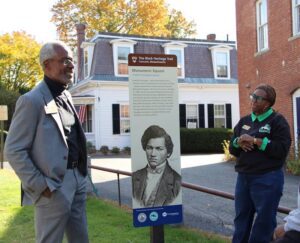
Concord School Committee Member Dr. Michael Williams, left, and Robbins House Board Co-Chair Nikki Turpin, members of the Black Heritage Trail Advisory Team, stand with the Frederick Douglass sign featured on the trail. (Photo courtesy town of Concord)
The town of Concord held an event last month dedicating a new Black Heritage Trail that highlights the history and contributions of Black Concordians.
Ten interpretive signs, designed in a style that complements existing historical signage in the town, are installed at key locations selected for their historical significance, documentation and accessibility. Sites include the house where Harriet Tubman stayed during her visit to Concord in 1859, three enclaves where Black families built communities, and the Universalist Meeting House where Frederick Douglass spoke in 1841.
The project seeks to accomplish a number of goals, including broadening education and understanding of the town’s history for both residents and visitors, increasing awareness of sites related to Black heritage, and supporting the town’s goal of building a more welcoming community.
“Part of the work we’ve been doing in town over the last few years, both at the municipal level and at some of the nonprofits, was to try to bring a more full story to Concord,” said Joe Palumbo, Diversity, Equity, and Inclusion Commission member and Robbins House co-chair. “Concord has a rich history that is well known, but the deeper layers of the history to make everyone feel welcome and included in the town have not been part of that narrative.”
The project had a budget of $28,000, funded by a grant from the Massachusetts Office of Travel and Tourism Destination Capital program and matching town American Rescue Plan Act funds.
The project was spearheaded by the town’s Diversity, Equity and Inclusion Committee and the Economic Vitality Division, as well as the Robbins House, a historic site that commemorates the legacy of a previously enslaved Revolutionary War veteran, and the Concord Visitor Center. An advisory team of 18 community members was formed to help guide the project.
“We had some of these public meetings, like the Historic District Commission, usually a pretty chill kind of meeting,” Palumbo said. “We had like 50, 60 people showing up online for these things in the dead of summer, because people wanted good things to happen.”
Economic Vitality Manager Mimi Graney said that even if the signs had not been approved, the town would have accomplished its goal of increasing awareness of the town’s Black heritage just through the well-attended meetings.
“The other goal was bringing Black history and Black presence into the public realm and the physical landscape,” Graney said. “People who are visiting Concord might look around and think there’s not a lot of people that look like me.
“The abolitionist story is [often] told from the white abolitionist who owns the house, rather than the people of courage that came from the South. … We really wanted to center those stories and put them into the landscape.”
Because the signs are meant to be educational and not monuments, they were relatively inexpensive to produce, Graney said. But erecting them entailed navigating the complexity of placing signs on public and private property, in some cases in different historic districts, in a town that sees significant historic tourism. She said Minuteman National Park sees about 1 million visitors annually, but that traffic does not always translate to Concord Center. A majority of the signs, however, are walkable within town and will bring traffic to the business district.
Graney and Palumbo said the partnership between town staff and volunteers was key to the success of the project, as was having support from Rep. Carmine Gentile, as well as having other communities to look to who have done similar work.
“We learned that you have to be willing to have honest conversations and do them in a way that’s respectful when you can, but be willing to hear voices that you may not have heard before,” Palumbo said. “The majority of the advisory team were members of the Black community that live here, work here, or go to school here. And there was power in what they said.”
“If any community is trying to get a more inclusive voice in town,” Palumbo said, “make sure the agency of the people who are behind it are in the conversation, and be ready when they speak up, and [if] people don’t know how to hear them, or don’t know how to respond to them, that you have people trying to coach people through that.”
The walking tour can be self-guided using printed maps located at the town’s visitors center or online, with a handful of scheduled tours available this month.