Who is a member?
Our members are the local governments of Massachusetts and their elected and appointed leadership.


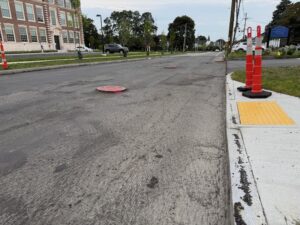 On April 15, the House took a significant step toward securing funding for local infrastructure maintenance by unanimously passing a transportation bond bill that would authorize $300 million for the Chapter 90 local road and bridge program for fiscal 2027.
The bill would maintain the historic benchmark funding level established by the Legislature last year, offering much-needed stability for cities and towns across the Commonwealth as they plan for the uncertainty of the upcoming fiscal year.
The legislation (H. 5375) continues a strategic funding distribution method that balances the complex needs of all 351 municipalities. Two-thirds of the Chapter 90 funding ($200 million) would be distributed using the traditional Chapter 90 formula, and the remaining $100 million would be allocated based solely on local road miles. The combination of the two formulas is designed to provide relief to rural communities that maintain extensive road networks despite having a more modest population size.
The bond bill also includes several significant authorizations aimed at modernizing the state’s infrastructure. These authorizations include:
• $200 million for transportation improvements to support expanded housing development
• $200 million for a new Parkway Resilience Improvement and Safety Modernization investment program
• $500 million for the state’s Bridge and Pavement Lifecycle Asset Management Programs.
“Local leaders across the Commonwealth are deeply grateful to the House for moving so decisively on this legislation,” said MMA Executive Director Adam Chapdelaine. “The Chapter 90 program remains the backbone of municipal infrastructure maintenance. By continuing this increased funding level, the Legislature is directly committing to improving the safety and reliability of our local roads. We want to thank all our legislative partners for their advocacy on behalf of our 351 cities and towns.”
The transportation bond bill has been sent to the Senate for consideration. Securing the authorization quickly will be vital for local officials, thereby allowing municipalities to put the funds to work quickly during the construction season.
“We are thrilled to see this momentum,” Chapdelaine added. “We also want to thank the governor and her administration for their early action and partnership on this issue, which remains a top priority for our municipalities.”