Who is a member?
Our members are the local governments of Massachusetts and their elected and appointed leadership.


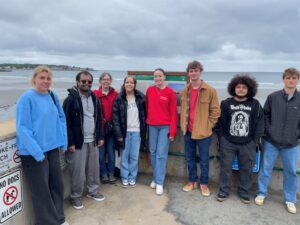
A team of student interns performed daily water quality testing at King’s Beach for the duration of the UV pilot project recently undertaken by Lynn and Swampscott.
A collaborative pilot program run by the city of Lynn and town of Swampscott used UV technology in an effort to clean up King’s Beach, which straddles the border of the communities.
The beach has some of the worst water quality in the greater Boston area due to two pipes, one in Lynn and one in Swampscott, that discharge stormwater into the ocean at the beach. The discharge mixes with sewage and other polluted runoff during wet weather, which can elevate bacteria levels at the beach and lead to frequent closures during the summer.
The problems at King’s Beach have been ongoing for years, and each community faces a different challenge when it comes to pollution at the site. In Lynn, the city separated its sewer and stormwater systems in the late 1990s, but the city has found numerous illegal sewer connections and may have missed some connections during the separation process. In Swampscott, the sewer and stormwater systems are separate, but aging infrastructure has made them prone to leaks over time.
“Part of the reason why this has been a problem for decades is because it’s complicated,” said Lynn Mayor Jared Nicholson. “It’s complicated scientifically, it’s complicated environmentally, but it’s also because it spans multiple jurisdictions.”
The communities formed a steering committee with the Lynn Water and Sewer Commission and other local stakeholders to evaluate options for cleaning the beach. This work largely focused on complementary solutions, as “the main strategy always has been and is going to be source elimination,” Nicholson said.
The committee worked with a consultant to identify potential solutions, which included redirecting the outfall, pumping stormwater into the wastewater treatment plant, chlorination and de-chlorination, extending the discharge pipe farther into the ocean, and UV sanitization. Ultimately, committee members opted for the UV treatment, which was more affordable, Nicholson said, “while still a substantial investment,” and offered “a more reasonable time frame as well as a more favorable regulatory outlook.”
The technology works by pumping stormwater into a tank, exposing it to powerful UV light to eliminate bacteria, and then discharging into the ocean. A team of interns conducted daily water quality tests for the program’s duration to mark project progress.
The municipalities received a $5 million earmark from the state for work at King’s Beach through advocacy from members of their delegation, including Sen. Brendan Crighton and Rep. Jennifer Armini, whose districts include the beach. Approximately $800,000 from that earmark went to the UV pilot program.
The UV pilot wasn’t an easy undertaking: heavy rainfall overwhelmed the system and churned up sediment, making the UV less effective, and project managers had to install grates to keep seaweed out of the UV tank.
Results were positive, however, as the UV treatment decreased bacteria at the beach.
“The system that was designed was working and it increased the number of days that the beach was open,” Nicholson said.
The next steps for Lynn and Swampscott are to use the pilot program data to evaluate the feasibility and location of a permanent UV facility. A 2023 estimate puts the cost at about $25 million.
“What has allowed us to make such incredible progress is really embracing this idea that this is all of our problem, and we need to work together to solve it,” Nicholson said. “That means having a sort of collaborative mentality and focusing on solutions.”