Who is a member?
Our members are the local governments of Massachusetts and their elected and appointed leadership.

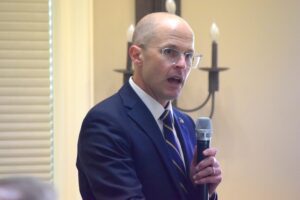
MMA Executive Director Adam Chapdelaine speaks during the MMA Fiscal Summit on Oct. 9 in Boylston. Chapdelaine discussed the MMA’s new fiscal conditions report, released the same day, that documents the forces putting financial pressure on Massachusetts municipalities.
The MMA held a Fiscal Summit on Oct. 9 in Boylston to discuss budget constraints facing the state’s cities and towns and to explore mitigation strategies.
The event coincided with the release of a major MMA report, “A Perfect Storm: Cities and Towns Face Historic Fiscal Pressures,” which examines the increasingly untenable municipal budget picture and invites a broader public discussion about local government funding.
MMA Executive Director Adam Chapdelaine highlighted the factors putting pressure on essential local services — rising costs, strict limits on local revenue-raising, and an erosion of municipal aid from the state since 2002.
“You’re all facing rising costs, inflationary cost pressures,” he said. “At the same time, the real inflation-adjusted dollar value of state aid is shrinking … and it’s putting immense pressure on all of your budgets. I’m sure you’re all experiencing it in your communities.”
Municipal leaders described their fiscal challenges during a question-and answer session, citing disparities among community tax bases, the difficulty in getting a Proposition 2½ override passed, rising special education costs, limited local input on state decisions affecting municipalities, and the challenges of complying with costly state requirements without adequate financial support.
“Unfunded or underfunded mandates, those are the killers,” said Mendon Select Board Member Michael Goddard. “Day-to-day operations, I think we can manage. But when we’re getting curveballs, whether it’s on the education side or the environmental side — those things, we have to scramble to fund.”
Later this year, the MMA will be releasing a set of policy recommendations — “a menu of solutions,” Chapdelaine said — to put cities and towns on more sustainable financial footing.
“We are really excited about this,” Chapdelaine said of the report. “I really do believe it puts a lot of data behind arguments that we’ve been making for a long time.”
Education costs

Peabody Schools Superintendent Josh Vadala, left, discusses cost drivers in public education during the MMA Fiscal Summit on Oct. 9 in Boylston. Also pictured is Sean Mangano, executive director of finance and operations for the Holyoke Public Schools.
Following the discussion of the MMA report, a panel explored the factors driving costs in public education.
Peabody Public Schools Superintendent Josh Vadala listed cost drivers such as the academic and social-emotional needs of students since the COVID pandemic; budget items that have traditionally driven up education costs, including health insurance, special education and transportation; and outside factors including collective bargaining, demographic changes, unfunded mandates, Chapter 70 funding, and Student Opportunity Act requirements.
“What I believe that we’ve seen since the pandemic is the Bermuda Triangle of school budgets,” Vadala said.
Sean Mangano, who was until recently finance and operations director for the Holyoke Public Schools and is now finance director for the town of Amherst, discussed ways municipal officials can address education budget growth, including:
• Meeting with school officials to understand cost drivers
• Considering partnerships with neighboring districts to expand purchasing power
• Evaluating current health insurance arrangements
• Considering regionalization for certain services
• Examining building uses
• Evaluating compensation for specialized positions that could be brought in-house instead of contracted out
“I think too often, people wait until they have a year where there’s a lot of budget reductions or some sort of crisis, and then they start looking at cost-saving strategies,” Mangano said. “And then, unfortunately, by that time, it’s almost too late. Schools have to make really devastating cuts — things that might have been able to be avoided if some of these things were done early.”
Public engagement
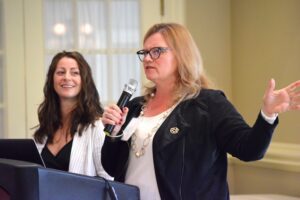
Reading Assistant Town Manager Jayne Wellman, right, joins Foxborough Communications Specialist Maura Buckley in a discussion about public engagement strategies for municipal finance and budgeting at the MMA Fiscal Summit on Oct. 9 in Boylston.
During the next panel, on public engagement strategies for municipal finance and budgeting, Foxborough Communications Specialist Maura Buckley urged proactivity. Residents notice if local governments reach out only when they need money, she said. Before financial requests arise, officials should build connection and trust with the public through “consistent, authentic communications” grounded in active listening and empathy.
“So sticking with that finance theme, every social media post, every article, every alert that you put out,” Buckley said, “that’s going to be a little deposit right here, in your public trust piggy bank.”
Buckley and Reading Assistant Town Manager Jayne Wellman also discussed trust-building strategies, including:
• Using storytelling to connect on a personal level
• Using different formats and communications channels to reach the public
• Prioritizing clarity, so messaging is comprehensible to less-knowledgeable residents
• Responding to residents’ concerns
• Building a team to help deliver messaging
• Ensuring that officials and boards work in alignment
Wellman urged officials to follow what people are saying online, because “you want to know what’s coming.” Communities should also understand where people get their information, she said. After a failed override in Reading, a survey revealed that 85% of respondents cited friends and family as their primary sources of information.
“Not the town website, not official newsletters, not the local media — it was who they’re talking to on the soccer field, what their nextdoor neighbor said to them, who they’re talking to when they go out for drinks on Friday night,” Wellman said. “So you want to talk to the people they’re talking to. Who are the influencers in your community that are getting the information and sharing it?”
Wellman said communities should get buy-in from every demographic for financial requests.
“We’ve definitely learned that your overrides, your projects have to have something for everyone,” she said.