Who is a member?
Our members are the local governments of Massachusetts and their elected and appointed leadership.

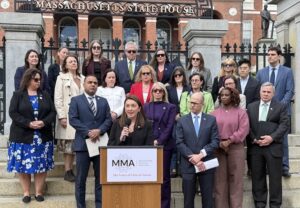
Amesbury Mayor Kassandra Gove, president of the Massachusetts Municipal Association, speaks at a May 12 press conference on a proposed income tax cut ballot question.
Municipal leaders from across the Commonwealth gathered on the State House steps on May 12 to strongly oppose a proposed ballot initiative that would cut the state income tax rate by 20%, thereby slashing state revenue and harming essential services to residents.
“For cities and towns, the consequences for this proposal are very real,” said MMA Executive Director Adam Chapdelaine. Only small portions of the Commonwealth’s budget are discretionary, he said, so “when state revenues decline, local aid becomes vulnerable.”
The projected $5 billion the proposed ballot question would take out of state revenue collections would “have a devastating effect all across the state budget,” he said.
“When municipalities lose state support, there are only a few options available: significantly reduce services, delay investments, or shift more pressure onto local property taxpayers,” Chapdelaine said. “This is not some abstract debate: this is about classroom resources; this is about ambulance response times; this is about whether communities can repair roads, hire teachers, support seniors, and keep libraries and parks open.”
Amesbury Mayor Kassandra Gove, president of the Massachusetts Municipal Association, said a significant reduction in state income tax revenues “deeply jeopardizes progress” in her city and across the state — threatening critical services and adding to the burden on local property tax payers.
“This adds insult to injury at a time when communities are already facing inflationary pressures, rising construction costs, health insurance increases, workforce challenges, and so much more,” she said. “Municipal leaders are not asking for luxuries. We are asking for stability, predictability, and the ability to continue providing the services our residents depend on.
“My residents expect safe streets, strong schools, functioning infrastructure, clean parks, reliable emergency response, and support for vulnerable populations. Those expectations are reasonable. But meeting them requires resources.”
Holyoke Mayor Joshua Garcia, president of the Massachusetts Mayors’ Association, said mayors and municipal officials “immediately understand” the potential implications when there’s discussion of a reduction of state revenues.
“It means uncertainty,” he said. “It means jeopardizing or reversing progress that residents can already see in their neighborhoods. And for gateway cities and communities with significant needs, the impacts can be even more severe.
“We cannot afford to pull resources away from education, transportation, public safety, and local government at a time when residents are asking us to do more, not less,” he continued.
“State funding is not ‘extra’ for communities like ours — it is foundational support that allows us to deliver core services and make long-term improvements as prudently as possible,” Garcia said.
“For residents,” he said, “this debate is ultimately about what kind of communities we want to live in. Do we want communities with strong schools? Safe neighborhoods? Reliable emergency services? Maintained roads? A responsive local government?
“If we do, then we must strongly oppose this ballot question,” Garcia said.
The ballot question’s opponents include the Healey-Driscoll administration, legislative leaders, public employee unions, and the Massachusetts Taxpayers Foundation, which cites fiscal irresponsibility and potential harm to public services.
Because the Legislature took no action on the initiative by an early May deadline, the next step in the process requires proponents to collect an additional 12,429 certified signatures from registered Massachusetts voters by June 17. Once local municipal election officials verify the signatures, the final certified papers must be filed with the Secretary of the Commonwealth’s Elections Division by July 1.
Following these steps, in order to qualify for the statewide ballot on Nov. 3, the initiative must also clear any remaining constitutional challenges or ballot language appeals overseen by the Office of the Attorney General and state courts.