Who is a member?
Our members are the local governments of Massachusetts and their elected and appointed leadership.

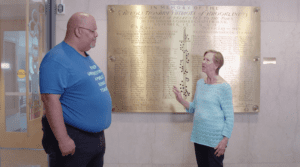
In an image from Hidden Brookline’s video tour of Brookline Town Hall, Malcolm Cawthorn, left, and Barbara Brown stand by a plaque in Brookline Town Hall honoring town residents who fought at the Battle of Lexington.
Visitors to Brookline Town Hall are greeted by a large metal plaque in the entrance that bears the names of Brookline residents who fought in the Battles of Lexington and Concord in April 1775. At the bottom are the names of three enslaved men who fought for the cause, but they’re recognized only by their first names and the names of the men who enslaved them.
The plaque is featured in a new video, called “Hidden Brookline,” that brings to light the history of enslaved people in Brookline. The video was developed and produced by Brookline’s Office of Diversity, Inclusion and Community Relations, in coordination with Hidden Brookline, a committee focused on understanding the history of slavery in Brookline.
The video features two guides: Barbara Brown, a retired professor and educational program director, and Malcolm Cawthorn, a Brookline High School history teacher and the town’s METCO director.
“Slavery in Massachusetts has been, across the state, hidden for over 225 years,” Brown said. “We have gotten so caught up in this simple narrative … that we hadn’t heard that there was slavery here.”
Brown began researching Brookline’s history to learn more about the area’s relationship with slavery. She developed walking tours that highlight locations throughout the town that are connected to the history of enslaved people of African descent who lived and worked in Brookline, as well as the town’s connections to slavery and the abolitionist movement.
“We have a more complicated history,” Brown said. “We also have wonderful things. It’s one piece of our history.”
While looking for ways to bring the walking tour to a larger audience, including Brookline Public School students, Brown had the idea to create a video, one that covered a place most residents know well: Town Hall. She reached out to Cawthorn, who had been involved in Hidden Brookline’s work, to see if he would be interested.
“We decided to make a video that classrooms could use,” Cawthorn said, “for those with limited mobility, or … for schools.”
Brown and Cawthorn partnered with Brookline Interactive Group, a local nonprofit and local media producer, as well as Lloyd Gellineau, Brookline’s chief diversity officer. Gellineau was able to secure funding for video production from the Brookline Community Foundation.
Brown leveraged existing relationships with local stakeholders, built through her research process, to compile information and resources for the video. These stakeholders included the Brookline Historical Society, Brookline Public Library, and the First Parish Church of Brookline, all of which have historical documents and artifacts related to the history of slavery in Brookline.
Brown and Cawthorn have plans to expand the video series into multiple parts to cover additional locations that are discussed on Hidden Brookline’s walking tours, as well as more recent history within Brookline.
This hidden history is “important to uncover to get a full picture of the town, the state, and the communities we live in,” Cawthorn said.
“There’s joy in revealing things that people didn’t know, and making it powerful for them to know and making it real,” Brown said.