Who is a member?
Our members are the local governments of Massachusetts and their elected and appointed leadership.

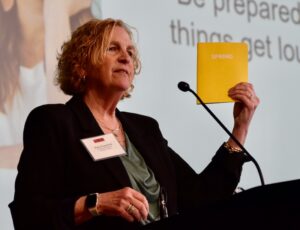
Kate Fitzpatrick, Northeast regional director at the International City/County Management Association and former Needham town manager, speaks during the Women Leading Government conference on March 5 in Worcester.
Women municipal leaders from around the state came together on March 5 to discuss productivity strategies and self-care, and to join colleagues from around the country for a SheLeadsGov virtual summit and “watch party” during the sixth annual Women Leading Government conference in Worcester.
Kate Fitzpatrick, a retired town manager and Northeast regional director for the International City/County Management Association, joined local alumni of the Women in the Civic Arena program for a discussion about the importance of making connections to create a support system in and out of the office.
During an interactive morning session, attendees used the work of author Kendra Adachi, of The Lazy Genius Collective, to discuss personal management strategies. Attendees answered questions about what they are working on and excited about, hopes for the spring, and more. In small groups, they addressed accountability around their needs.
“How can you work together to come up with a strategy where you can take one step toward what you want to do next and commit to reaching out to each other over the next month to see if you’re getting there,” Fitzpatrick said.
Attendees discussed issues like creating “fake” appointments on their calendars to get work done, breaking out of the municipal bubble to see the broader local story, making time to notice what’s going on around them, and work-life balance.
Later in the morning, attendees worked with Daniel Pink’s “2026: Designed” workbook and his four-part podcast series, to reflect, prioritize and build a framework for the year. Prompts included their biggest regret of 2025, what they learned and how they’ll you act upon it, and one word to define how you want to live.
They discussed strategies, such as:
• Protecting your first hour (of your day or your workday)
• The “two minute rule” (if something can be done in two minutes then just do it)
• A weekly reset
• Developing a network of people who will challenge you
SheLeadsGov
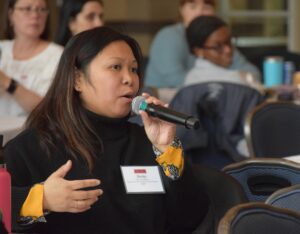
Zosia VanMeter, inspection division director for Lynn, asks a question during during the Women Leading Government conference on March 5 in Worcester.
The second half of the day focused on the SheLeadsGov virtual summit, “Own Your Local Government Influence.”
A virtual panel for strategic communication for women in leadership roles asked panelists to reflect on communication as a superpower, and on the importance of commanding the message, both personally and professionally.
“I see it as a leadership discipline, not a press function,” said Susana Carbajal, assistant city manager in Austin, Texas. “When we communicate clearly and eliminate confusion, I think it builds community trust. It also develops trust with our own teams.”
When shaping a message, it’s important to consider the desired outcome, how the intended audience will interpret it, and how to achieve clarity.
“It’s not just what you say,” said Sharon Subadan, city manager in South Fulton, Georgia. “It’s how you say it, when you say it, and why you say it, that can define your leadership.”
Heather Strickland, senior director of communications at North Carolina’s Department of Health and Human Services, said message mapping and strategic planning are valuable activities, to prepare for conversations that can shift quickly.
“It’s really easy to really get lost in all the mechanics of how things work and how systems change and how policy impacts people,” Strickland said. “But what we have to talk about is how people are benefiting from the work that we’re doing.”
Panelists discussed how conversations with elected officials, staff and the public should be handled differently. For example, with staff it’s important to explain how you can help them achieve their goals. With the public, it’s important to listen first to identify concerns, meet people where they are, and be as transparent as possible.
Storytelling can be foundational to connect with residents and explain projects or policies. Sharing personal stories can bring a level of humanity to a public position and build trust.
“It’s one thing to trust that somebody knows what they’re talking about,” Strickland said. “It’s a whole other thing to trust that a leader has integrity as they’re doing that work — and storytelling is what gets you there.”
Well-planned communication practices can help connect local leaders with residents, foster effective relationships, and support success.
“Often we’re evaluated on our delivery and our ability to deliver and communicate before we’re evaluated on our results,” Subadan said.
Leading through change
The second virtual session, on women leading through change, discussed the importance of influence over authority, and how influence can show up in different ways.
Emily Colon, a partner at The Southern Group and a member of the SheLeadsGov Committee, recalled a time when she was brought in to lead a department in crisis and was met by a team that had many years of experience.
“You have to earn the choice to be influential,” she said, in part by being a team player.
Marcia Frazier, the city manager in Douglasville, Georgia, said leaders need to understand the power of empathy, and have the ability to understand all sides.
“I don’t think I’ve met a person yet — even in the most hostile environments — that, when I start to deliver their message back to them with understanding, there is not some level of recentering,” Frazier said.
Key features of a strong leader are recognizing the environment you’re in, the strengths you have, and the strengths of your team.
“And you just have to know that you are who you are, and you have a gift that is truly your own gift … and to bring that to wherever you go,” said Ginger Spencer, assistant city manager in Phoenix, Arizona.
Prioritizing rest is essential to avoiding burnout, panelists said. Spencer recommended scheduling time to disconnect and rest, read, engage in movement or practice hobbies.
Each panelist offered strategies to improve leadership skills.
“Stay curious,” Colon said. “You build relationships when you ask questions. … You’re a better leader when you know the people.”
Frazier advised doing a self-assessment of the things that you’re doing, personally or professionally, and what it is adding up to. Is it taking you where you want to go, even if that is right where you are?
Spencer advised those starting their careers to aim for their highest goal. Those in mid-career or making a change should be sure to take their seat at the table and bring something to contribute. And those with experience in leadership roles should pass the baton to the next generation through mentorship.