Who is a member?
Our members are the local governments of Massachusetts and their elected and appointed leadership.


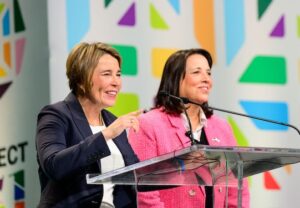
Gov. Maura Healey and Lt. Gov. Kim Driscoll spoke to some 1,400 city and town leaders from across Massachusetts on Jan. 23 during Connect 351, the MMA’s annual conference, in Boston.
Gov. Maura Healey and Lt. Gov. Kim Driscoll spoke to some 1,400 city and town leaders from across Massachusetts this morning during Connect 351, the MMA’s annual conference, in Boston.
In an appearance that came the morning after the governor’s State of the Commonwealth address, and five days before she is due to file her state budget plan for fiscal 2027, Healey and Driscoll touched on a number of their priorities, including affordability, housing, energy costs, health care and the popular Community One Stop for Growth portal.
The governor spoke about the budget only in broad strokes, but separately released details today regarding local aid accounts.
The administration said the governor’s budget bill, known as House 2, will propose a 2.5% increase for the main discretionary municipal aid account — Unrestricted General Government Aid — an addition of $33 million for 351 cities and towns.
On Chapter 70 aid for K-12 public schools, she said her budget would fully fund the sixth and final year of the phase-in plan for the Student Opportunity Act at $7.6 billion, a $242 million increase over the current year. House 2 would fund minimum per-pupil aid at $75.
The Special Education Circuit Breaker account would be fully funded at $802.7 million, with $652.7 million included in House 2 and $150 million coming from a fiscal 2026 supplemental budget allocating Fair Share Amendment surtax revenue.
Healey said her budget would increase rural school aid by $8 million, to $20 million.
The governor said she would also be filing a multi-year bond bill for the Chapter 90 local road and bridge program, providing $300 million per year for the next four years. The Chapter 90 program, which benefits all 351 Massachusetts cities and towns, was increased by 50%, from $200 million to $300 million, for the current fiscal year.
“We’re very thankful for the governor’s proposed targeted investments in education, rural schools, and roads and bridges,” said MMA Executive Director Adam Chapdelaine. “We appreciate her proposal for Unrestricted General Government Aid, which we see as a starting point for a continuing conversation, given the overwhelming need for essential municipal services.”
Healey also announced the launch of a Funding for Accelerated Infrastructure Repair (FAIR) program to fund local, municipal transportation projects across the state. The program, supported by leveraging Fair Share income surtax revenue to expand borrowing capacity, will help municipalities work through their backlog of municipal bridges in need of repair. The investment is made possible by the expansion of the Commonwealth Transportation Fund through the governor’s $8 billion transportation plan.
FAIR investments will be used to reopen closed bridges, remove postings on restricted bridges, and preserve additional bridges from falling into either category, the administration said. Projects in Berkshire, Franklin, Hampden and Hampshire counties are already being evaluated, with additional locations to follow. The FAIR program is intended to reduce administrative burdens.
Driscoll discussed the administration’s 10-year transportation plan, which includes an Accelerated Bridge Construction program.
Healey and Driscoll also promoted her proposed Municipal Empowerment Act, which would modernize local authority, expand municipal flexibility, and provide targeted local revenue options. The package is strongly supported by municipal officials and the MMA.
“There’s a lot of reform in there,” Driscoll said. “We’re really hoping to get that over the goal line. It’s going to take your help and advocacy.”
On the state’s housing shortage, the governor said 100,000 units have been “built, permitted or are under construction” in the past three years, but more must be done to close a gap estimated at 220,000 housing units. Healey and Driscoll noted that the need for “workforce housing” is critical for economic development as well as for municipal employees.
Options on the table, Healey said, include the promotion of office-to-housing conversions and using state-owned land for housing. She thanked local leaders for their efforts related to the MBTA Communities Act, which requires zoning for multifamily housing near transit nodes.
“We’re going to continue to stay laser-focused on building more [housing] and building faster,” Healey said.
Healey and Driscoll highlighted the administration’s efforts to preserve health insurance coverage for 270,000 residents in the face of drastic federal funding cuts, and the formation of a health care affordability task force.
Regarding energy costs, Driscoll said more than 180 communities have signed up for municipal aggregation programs in order to reduce electricity rates for their residents and businesses.
“Now’s the time to do it,” she said. “We’re saving hundreds of millions of dollars for ratepayers through municipal aggregation.”
This story has been updated with additional material since its initial posting.