Who is a member?
Our members are the local governments of Massachusetts and their elected and appointed leadership.

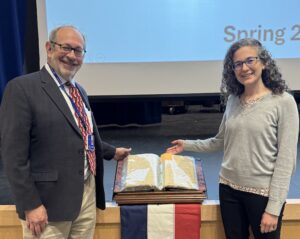
Natick Town Meeting Member Joshua Ostroff, left, and Natick Historical Society Director Niki Lefebvre stand with the town’s original Resolve for Independence document, which was endorsed by Natick Town Meeting in 1776. (Photo courtesy Joshua Ostroff)
As the country prepares to celebrate its 250th anniversary, residents around the Commonwealth are using their annual town meetings as a platform for reflecting on the nation’s founding and recognizing the role that town meeting played in the lead-up to the American Revolution.
North Andover Town Moderator Mark DiSalvo, president of the Massachusetts Moderators Association, wanted to create a project for the association that coincided with the 250th anniversary of the signing of the Declaration of Independence. He recruited Longmeadow Town Moderator Rebecca Townsend, a former president of the association, to assist with the effort.
“The 250th anniversary of the American Revolution offers us an easy chance at reflecting on why we’re doing what we do,” Townsend said. “Town meeting is essentially the same kind of environment that it was 250 and nearly 400 years ago, when it was first crafted as a form of self-governance — and that heritage deserved both celebration and reinforcement in both of our views.”
In 2024, the Moderators Association began the Spark of a Revolution initiative, which highlights the role of town meetings in colonial America and the outset of the American Revolution.
In 1774, the British government passed an act banning town meetings, but towns continued meeting in defiance of the act, barring the doors to prevent British soldiers from entering. By 1776, nearly 60 towns discussed independence from British rule during their town meetings, with some issuing their own declarations in support.
DiSalvo and Townsend wanted to recognize the right to self-govern established by those town meetings 250 years ago.
“The warrant was called in the name of the king prior to 1776, and then there’s a switch to, ‘in the name of the people,’” said DiSalvo. “In Princeton, for example, the clerk began writing ‘in the name of the king,’ and crossed it out to then write ‘in the name of the people.’”
DiSalvo and Townsend have been urging town moderators throughout the Commonwealth to recognize the historic relevance of the town meeting form of government through formal statements made to local press, social media, and at public meetings.
There was near-unanimous support among moderators for the effort, DiSalvo said, with many incorporating local history associated with the American Revolution into their statements. Some went a step further: the town of Lincoln reenacted the community’s 1774 town meeting, while Reading and Lynnfield staged one-act plays.
In Natick, one of the 60 towns to discuss independence in 1776, former Select Board Member and current Town Meeting Member Joshua Ostroff developed a warrant article recognizing the town’s June 1776 Resolve for Independence, independent of the Moderators Association initiative.
“I felt it was important to not just memorialize what we did around the Natick Resolve for Independence, but to contextualize it with where we are today,” Ostroff said.
DiSalvo, Townsend, and Ostroff all acknowledged the paradoxical nature of the early resolutions for independence: Indigenous claims and rights to land were not acknowledged, slavery was legal throughout the colonies, and the only people who could vote and participate in government were white male landowners.
Ostroff said town meeting provides valuable lessons 400 years after its inception in Massachusetts.
“The spirit of debate is foundational to town meeting and to our country,” Ostroff said. “And even if people have strong disagreements, we resolve our differences peacefully through debate and voting.”
As town meetings have grown and become multi-day events, some may wonder whether this form of government remains efficient and effective in the modern era. DiSalvo said town meeting is far from being anachronistic and redundant, as it provides an outlet for residents to share power and make decisions about their shared future.
“In town meeting, you get the chance to humanize the votes,” DiSalvo said. “You’re not hiding away in some secluded voting booth and ending someone’s job with a decision on a referendum. You have to confront people face-to-face and be aware of the impact of your decisions.
“The continued practice of town meeting, by itself, affords its preservation,” he said. “You learn democracy by doing democracy.”