Who is a member?
Our members are the local governments of Massachusetts and their elected and appointed leadership.

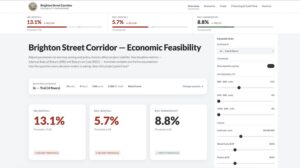
The town of Belmont’s new digital feasibility tool, developed in partnership with Harvard University, will help residents, staff and developers to evaluate financial feasibility along the proposed Brighton Street Corridor.
The town of Belmont partnered with Harvard University to develop a feasibility tool to help residents understand how developers may evaluate financial returns when considering projects in town.
The Development Financial Feasibility Tool arrives as Belmont officials are working to create an overlay zoning district along the Brighton Street corridor, which would include numerous subdistricts with their own zoning principles related to development.
The tool allows users to evaluate whether a proposed development can realistically be built and financed under a given set of zoning and policy choices.
These measures “determine whether a project should ‘pencil out’ or, more formally, would provide the necessary profit to secure funding,” said Belmont Planning and Building Director Chris Ryan.
“Up to this point, we’d had the opportunity to conduct developer focus group sessions and also had discussions with individual developers and other real estate market analysts,” Ryan said. “But we never had a tool that could validate assumptions and key variables in the developer’s ROI formula.”
Ryan said that the tool is also an effective engagement method that demonstrates the town’s commitment to gathering resident perspectives and answering any questions they have.
Belmont’s partnership with Harvard came from work with the Harvard Kennedy School to develop materials for a vision plan for the Brighton Street corridor through a lab course where students work with municipal clients to solve critical issues.
“We had just completed a successful upzoning of Belmont Center based on a vision plan document, and we wanted to have something similar as a foundation to an upzoning of this area as well,” Ryan said.
Belmont and Kennedy School staff discussed what Kennedy School students could do to follow up on the effort and provide additional value for the Brighton project. The result of that conversation was a second lab class that delivered the feasibility tool.
Kennedy School student Josh Young then began working with the town through a public finance fellowship to refine the tool, create an interactive dashboard, and build out resources to support the project as it went live.
“One key to the value of the tool is its flexibility to be adapted to a range of projects,” Ryan said. “It models residential and mixed-use development, both rental and for-sale, and its structure can be adapted to other project types.”
Ryan said the town can use the tool to create an independent assessment of potential profit thresholds and verify developer claims that they require a specific zoning scenario for a project to be successful.
The town is also working with TangiblEmpact, a land-use planning startup, to create another tool that evaluates development feasibility and fiscal impact for development projects, analyzes potential impacts to traffic and infrastructure, and allows for 3D modeling of a project area.
Ryan said consistent engagement, establishing clear timelines, and providing both data and stakeholder connections to students were essential to the partnership’s success.
“These types of projects provide valuable information and planning to the town that we do not always have the capacity for on top of our regular day-to-day work,” Ryan said. “So we are grateful for the opportunity to work with so many talented students.”