Who is a member?
Our members are the local governments of Massachusetts and their elected and appointed leadership.


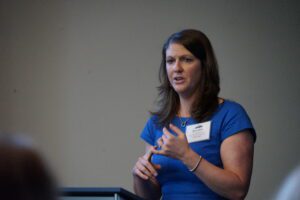
Meredith Harris, executive director of the Marlborough Economic Development Corporation, discusses her office’s work during a Massachusetts Municipal Councillors’ Association regional meeting on April 10 in Watertown.
As communities navigate choppy fiscal waters, long-term planning and buy-in from all stakeholders can help to mitigate budget pressures, according to local leaders at the April 10 regional meeting of the Massachusetts Municipal Councillors’ Association in Watertown.
During the meeting, titled “How Fiscal Policies Shape Our Communities,” several dozen councillors learned about Marlborough’s economic development efforts, Watertown’s fiscal strategy and budget philosophy, and the MMA’s recent fiscal reports and efforts to improve the financial ecosystem for cities and towns.
MMCA President Lisa Feltner, a Watertown city councillor, hosted the meeting in a new life-sciences development that was constructed during the city’s building boom in recent years.
Meredith Harris, executive director of the Marlborough Economic Development Corporation, said her quasi-public office supports the city’s businesses and helps bring additional revenue to the city, which is located in western Middlesex County with convenient access to major highways. The corporation works with city officials and departments to create a more “business-friendly” atmosphere for companies.
“We’re really trying to put Marlborough on the map, and not just in the Commonwealth, but throughout the country,” Harris said. “So when a Moderna or a Sartorius is looking for their next home, their next corporate headquarters, Marlborough is on their mind.”
Since the Marlborough Economic Development Corporation was created two decades ago, the development-related revenue brought in through its efforts has helped Marlborough maintain one of the highest unused levy capacities in the state, and has helped limit residential tax increases to less than $200 per year on ave
rage during most of the past 15-plus years, said Marlborough City Council President Michael Ossing.
“It allows the council to make moves and decisions on projects, zoning, schools, and fire stations that have minimal impact on the taxes,” Ossing said, “which is really beneficial.”
Created by a home rule petition, the corporation gets its funding from the city’s local hotel tax, and spends about $800,000 annually on economic development, Harris said. The office also supports small businesses and fosters an ecosystem benefitting both businesses and workers. The extensive collaboration between her office and city departments is critical to the city’s economic development success, she said.
Watertown City Auditor Megan Langan gave a presentation that described how her city’s fiscal policies have helped it build a new high school (soon to open) and two elementary schools, and renovate a third elementary school, without seeking an override or debt exclusion, and while maintaining a AAA bond rating.
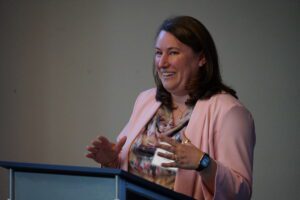
Watertown City Auditor Megan Langan describes her city’s fiscal strategies during a Massachusetts Municipal Councillors’ Association regional meeting on April 10 in Watertown.
Watertown is now looking at other potential projects, including a new middle school, a new senior center, fire station upgrades in the city’s East End, and a redesign of Watertown Square.
Langan said the city’s successes have been years in the making, tied to effective long-range planning.
“You have to give so much credit to the prior administration and to the council of 20 years ago for having this foresight, and developing these policies and thought processes of how to put this money aside for the future,” Langan said. “If they hadn’t done it 20 years ago, we wouldn’t have been in the position that we are now.”
Langan said Watertown has exercised fiscal discipline, and has a year-round budgeting process, annual financial audits, aggressive capital improvement planning, and a focus on economic development. Watertown has aggressively paid down its obligations for other post-employment benefits (primarily health insurance for retired employees), Langan said, and relies on 11 different stabilization funds, directing money into them during healthier years. The strategy has freed up money for other priorities, including helping to reduce the amount of borrowing needed to fund large-scale projects.
“We’re really trying to budget for flexibility,” Langan said. “We intentionally build contingencies into our financial DNA, which allow us to pivot as economic conditions evolve without having to ask more of our taxpayers.”
MMA Legislative Director Dave Koffman discussed the MMA’s recent “Perfect Storm” and “Navigating the Storm” reports, which outline the fiscal challenges faced by Massachusetts municipalities and offer proposed solutions to provide local governments with more support, strengthening the local-state partnership and providing more budget flexibility at the local level.
With communities facing escalating costs — particularly for employee health insurance, energy and construction — and strict limits on their revenue-raising ability, Koffman identified several MMA recommendations, leading with a restoration of adequate and reliable state aid. Additional options include allowing communities additional flexibility under Proposition 2½, subject to approval by local voters, prioritizing key local aid accounts such as those related to education costs, a modest expansion of local revenue options, and alleviating outdated administrative burdens and modernizing municipal practices.
“There’s no silver bullet,” Koffman said of the MMA’s recommendations, “but [the reports] say there’s a lot that we can do. There’s a lot that we need to move forward in policy, to give our cities and towns, obviously, resources. … It’s about different tools that can help them through all these different budget challenges.”