Who is a member?
Our members are the local governments of Massachusetts and their elected and appointed leadership.


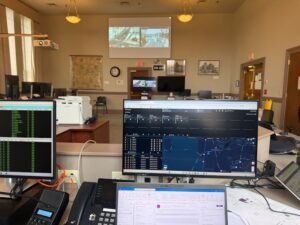
In its retrofit of the Town Council meeting room, Amherst added emergency dispatch equipment so that the room could also be used as an emergency operations center when needed. (Photo courtesy town of Amherst)
After a recent retrofitting, the Amherst Town Council meeting room can be used for any number of activities — public comment, procedural votes, and emergency operations.
Several months ago, the town began updating the room for a dual purpose: to hold public meetings and to function as an emergency operations center. The upgrades will allow officials to coordinate public safety responses during large-scale community events and emergencies such as natural disasters and water shortages.
Communities often locate emergency operations centers in public safety buildings, but Amherst officials said the council room offered more space and better technology than other facilities in town. The project dovetailed with town efforts to enhance its emergency preparedness, as well as its real-time response to larger events and incidents, according to Fire Chief Lindsay Stromgren, who serves as the town’s emergency management director.
“I think it’s awareness about being ready for things that go beyond the day-to-day activity,” Stromgren said. “You know, we’re dealing with emergencies all day, police and fire every day. It’s just trying to show [the public] that the town needs to be ready for other things.”
The town activated its new emergency operations center for the first time on March 7, to coordinate its response to an unsanctioned, off-campus gathering involving UMass Amherst students — an annual tradition that has historically resulted in alcohol-related arrests and medical responses. The town wanted to test its new EOC on an anticipated event, rather than an unexpected emergency.
In previous years, Amherst public-safety officials would join their university counterparts at UMass Amherst’s EOC. The university’s EOC is nice, Stromgren said, but the town lacked a home field advantage, technologically speaking, by being at an external facility.
“So to go do an away game, as we call it, at the UMass EOC just made it tough for us to have all the technology and resources that we wanted,” Stromgren said, “which is obviously computer internet access, but beyond that, ideally we want to be into our network, because there are things we can get to more easily on our network versus over the internet.”
The council room already had wifi, ample seating, and network connectivity, as well as projectors and a large screen for council meetings. The room is also located near several town departments, additional meeting rooms, bathrooms, and breakroom amenities that could be helpful for multi-day events, said Sean Hannon, the town’s information technology director.
Hannon’s department had to ensure that all network and power outlets were functioning properly, and that they could run radio communications out of Town Hall and over their network. They also set up a dispatch area for use during EOC operations.
Stromgren and Hannon said the March 7 test went well, with participation from the town manager’s office, the Amherst police, fire and IT departments, state police, the local hospital system, the Massachusetts Emergency Management Agency, and UMass, which also had its EOC operating.
During the event, Hannon’s team created a Zoom feed from cameras around town, and three drones flying overhead. Officials could watch the images on the big screen in the EOC, Stromgren said, and send the link out to incident commanders out in the field and over to the UMass EOC.
So far, the upgrades have cost the town IT staff time and about $15,000 for additional dispatch equipment, officials said. Going forward, Amherst also wants to purchase standalone radios, costing about $30,000, to storm-proof the EOC during power outages. The town hopes it can secure state emergency management grant funding through MEMA to defray the costs.