Who is a member?
Our members are the local governments of Massachusetts and their elected and appointed leadership.


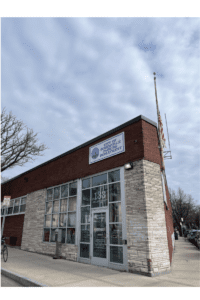
The Parking Office building, on Holland Street, will become Somerville’s first city-owned decarbonized municipal building.
Advancing its climate goal commitments, Somerville will be working this summer to fully decarbonize its first municipally owned building, the Traffic and Parking Office.
The two-story building in West Somerville, was chosen as the first for decarbonization because its three gas-fired boilers were beyond their expected lifespans and the city faced a costly decision of whether to replace them. The building already had infrastructure and electrical service in place to make installing an electric heat pump easier.
“The largest portion of the city’s fossil fuel use is in our buildings,” said Mayor Jake Wilson, “and upgrading them to sustainable systems is going to be a monumental undertaking. So this is an important milestone.
“We’re replacing ancient boilers and a leaking cooling system with green systems that will get the building to 95% clean energy quickly — and ultimately to 100%. Climate change is here now, so it’s time for action — one building at a time.”
The boilers and a rooftop unit will be replaced with a new heat pump air handler and basement heat pump units for heating and cooling. The city will also install a new 67-kilowatt rooftop solar array that will be the largest city-owned installation.
Winterization work and other exterior improvements will also be completed. Full decarbonization will be achieved once a relatively new gas-fired hot water heater reaches the end of its useful life and is replaced with an electric unit.
Garrett Anderson, energy manager in the Office of Sustainability and Environment, and technical lead for the project, said the city used a Chapter 25A procurement process for the project — an option specifically for energy efficiency and renewable energy projects.
“You get a little more flexibility,” Anderson said. “You can do more of a design-build scenario. It’s a little less onerous on the city to prepare.”
The project is expected to cost $353,731, after taking state and federal tax credits into account. The funding will come from the city’s Energy Stabilization Fund, which sets aside funding for energy saving projects. Projected annual savings for the city, based on the property’s current gas and electric utility costs, is $18,833.
When the city updated its Climate Forward plan in 2024, a concerted effort was made to look at municipal greenhouse gas emissions.
Emily Sullivan, climate change program manager in the Office of Sustainability and Environment, said the city-owned building was a great candidate for such a project.
“There are really good incentives and streamlined procurement processes to do this work,” she said. “So finding those Goldilock projects that further the values that we want to operate under as a city government, [that is] what our community’s looking at us to do.”
Based on community feedback, the city included greenhouse gas emission reduction goals for municipal property for 2030 and 2040 when it reworked its climate plan. The goals allow the city to better report on benchmarks and stay accountable to the work, Sullivan said.
Any municipality looking to retrofit older buildings to meet emission goals should start by getting a handle on electrical infrastructure, Anderson advised. Even simple lighting upgrades can have an impact.
He also suggested having a “champion” in the city or town who has a handle on the portfolio and ongoing capital replacement and maintenance, and who can identify potential energy projects and whether energy-related work can be done ahead of or in conjunction with other projects.
Lining up smaller capital projects comes down to finding the right project and the right timing around replacing equipment and public construction costs, he said.
Somerville is also conducting comprehensive building assessments for every school building and the public works headquarters, the first step of energy efficiency studies. The new Winter Hill School building will also be fully electrified.