Who is a member?
Our members are the local governments of Massachusetts and their elected and appointed leadership.


Mass Innovations, From The Beacon, October 2026
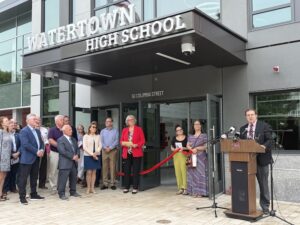
As local and state officials look on, Watertown City Manager George Proakis, far right, speaks during the ribbon cutting for the new Watertown High School on Sept. 2.
When Watertown High School students returned to school last month, they stepped into a new building that officials are hailing as a national model for sustainable school construction.
The city’s new $219 million educational facility is the first high school in the country to achieve both net-zero energy and LEED 4.1 Platinum standards, reaching the highest certification tier for energy efficiency and sustainability.
Officials say the new 200,000-square-foot building, which replaced a century-old structure and is the largest capital investment in Watertown’s history, reflects the community’s commitment to sustainability, both in terms of the climate and the city’s approach to municipal finance.
Joined at a Sept. 2 ribbon cutting and open house by State Treasurer Deborah Goldberg, state legislators, city and school officials and the high school choir, Watertown City Manager George Proakis told the crowd of students and residents that the finished building represents a collaborative effort by state and local government — and the community.
“The opening of a new high school is not only a seminal moment for the city, but it is a day that we set the standard for what a high school can be in this nation,” Proakis told the crowd. “We’re standing in front of a school that is truly one of a kind in the United States, combining energy efficiency with innovative learning spaces.”
The environmental designation means that the high school will produce as much energy as it uses. The building was constructed using paint, flooring and furnishings that avoid harsh chemicals and off-gassing (the release of harmful chemicals into the air), and more than 95% of the demolition debris from the old school was recycled. The building, which was designed for 720 students but can accommodate more, will be monitored for indoor air quality.
The school makes use of solar panels for electricity, heat pumps for the academic areas, and geothermal technology for the larger, community spaces, with 14 geothermal wells dug 1,000 feet into the ground. Outside, vertical sunshades reduce indoor solar glare and heat. Inside, low-flow plumbing fixtures reduce water usage.
The school’s 4.27-acre campus will use rain gardens to help manage stormwater, grow native plants to protect local habitats, and encourage bicycling with the installation of bike racks.
Throughout the school, a wave motif echoes the nearby Charles River and reflects the school’s, and the community’s, commitment to the environment. Long a champion of energy-efficiency and sustainability efforts, Watertown was the first New England municipality to pass a rooftop solar requirement for major developments, and was one of the first Massachusetts communities to adopt the state’s new specialized stretch energy code in 2023. In May, Lt. Gov. Kim Driscoll visited the school construction site and recognized the city’s efforts as one of the state’s Climate Leader Communities.
The effort to build the nation’s most sustainable high school was intentional, said City Council President Mark Sideris, who also serves on the Watertown School Building Committee.
“The impetus and steadfast commitment to achieve net zero and LEED Platinum came from Watertown — the city leaders and the community,” he said. “The goal was set at the beginning of the project. And even in times of historic cost escalations during and post-COVID, the message was clear to the project team that they would not waiver from that goal.”
Against the project’s total $219 million cost, Watertown received more than $50 million from the Massachusetts School Building Authority. The city borrowed the rest without seeking a property tax increase through a Proposition 2½ debt exclusion.
Watertown’s ability to build the high school and undertake three other school construction projects in recent years, without raising property taxes, is attributable to tax revenue realized from the recent local biotech lab building boom, city officials said, as well as decades of cautious financial planning. During the ceremony, Proakis recognized the financial discipline of his predecessor, the late Michael Driscoll, as two residents held up large signs with Driscoll’s photo.
“We are just four square miles in size and just over 35,000 in population, but our ambitions and our visions have been so much bigger,” Proakis said. “And this school is a reflection of our community’s values, our commitment to future generations, and our ability to come together and achieve something remarkable.”
For more information, visit the Watertown School Building Committee’s website.