Who is a member?
Our members are the local governments of Massachusetts and their elected and appointed leadership.


Lynn Mayor Jared Nicholson, Northampton Mayor Gina-Louise Sciarra, Gardner Mayor Michael Nicholson, and Cambridge City Manager Yi-An Huang (l-r) testify before the Joint Committee on Municipalities and Regional Government on Oct. 28 in support of Gov. Maura Healey’s proposed Municipal Empowerment Act.
More than 20 local leaders from across Massachusetts joined the MMA and Lt. Gov. Kim Driscoll at a hearing yesterday to urge legislators to support the administration’s proposed Municipal Empowerment Act — a multifaceted package of reforms and local options intended to cut costly red tape and improve local government efficiency.
The hearing before the Joint Committee on Municipalities and Regional Government focused on provisions in the bill that would impact local government operations, such as codification of the authority to hold public meetings remotely, reforms to complicated procurement rules, and stronger enforcement provisions for the removal of doubled up utility poles.
At a time when municipal governments across Massachusetts “are facing mounting fiscal pressures unlike anything we’ve seen in decades,” MMA Executive Director Adam Chapdelaine testified, the administration’s bill could make a meaningful difference.
“What we can do is provide our local governments with additional tools, flexibility, and authority they need to adapt, modernize, and operate more efficiently,” he said. “And that’s exactly what the Municipal Empowerment Act delivers.”
The legislation is intended to help local governments streamline operations, reduce mounting fiscal pressures, and attract a talented workforce. Its 50-plus provisions would provide tools for communities to solve age-old problems through operational flexibilities and allow for additional revenue options.
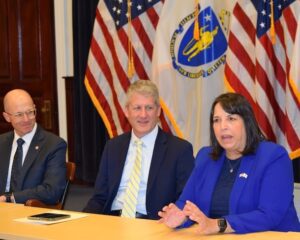
MMA Executive Director Adam Chapdelaine, MMA President and Franklin Town Administrator Jamie Hellen and Lt. Gov. Kim Driscoll (l-r) gather with local leaders from across Massachusetts just prior to testifying in support of the Municipal Empowerment Act on Oct. 28.
The bill has been split up to be reviewed by three legislative committees: the Joint Committee on Municipalities and Regional Government, the Joint Committee on Revenue, which will hold its hearing on Nov. 7, and the Joint Committee on Public Service, which held a hearing on Sept. 22.
Municipalities and Regional Government
Municipal Empowerment Act provisions considered by the Municipalities and Regional Government Committee include the following:
• Aligning procurement procedures for snow hauling services with the procurement procedures for snow removal
• Equalizing thresholds under Chapter 30B for advertised procurements to $100,000, which would bring all municipal purchases in line with changes made last year through the School Operational Efficiency Act
• Enabling groups of cities and towns to award multiple contracts through the RFP process and purchase both supplies and services from collectively bid contracts
• Extending bond terms for school borrowing projects from 30 years to 40
• Allowing for the amortization of emergency deficit spending over three years rather than having to account for all costs in one year
• Giving municipalities enforcement authority with penalties for utilities that fail to comply with state law requiring timely removal of double poles
On the topic of remote and hybrid meeting options — first allowed during the COVID pandemic — Chapdelaine pointed out that they have made local government “more transparent, more effective, and more efficient.” While the Legislature has extended the options several times, the proposal in the Municipal Empowerment Act “just codifies this understanding.”
“In total, the provisions [of the governor’s bill] create a meaningful framework for support and local innovation,” he said. “They give local leaders expanded capacity to manage today’s challenges and prepare for tomorrow’s.”
Lt. Gov. Kim Driscoll testified that the administration’s bill “is meant to support the municipal leaders of our 351 cities and towns as they deliver for the people of this state.”
“We believe that this bill is comprehensive and addresses the need for municipalities to have increased flexibility, increased efficiency and resources,” she said.
• Visit the administration’s Municipal Empowerment Act portal for more details